46. Model Calibration
Models should always represent disease progression and treatment effects as accurately as possible. This is a challenge as disease progression in models results from your patient pathways and several independent model inputs.
Calibration essentially tests the fit of your model output to expected clinical results, adjusts inputs and checks again through an iterative process. The input values found through calibration will generate results that more closely mirror the clinical data, resulting in a more accurate model.
Prior to running calibration, you must do the following.
-
Setup the calibration with the appropriate optimization algorithm and tolerance levels.
-
Identify the model inputs to adjust.
-
Add clinical target data to the model.
-
Identify model outputs to match to the target data.
The calibration process then adjusts the model input values iteratively to match model outputs against your target data.
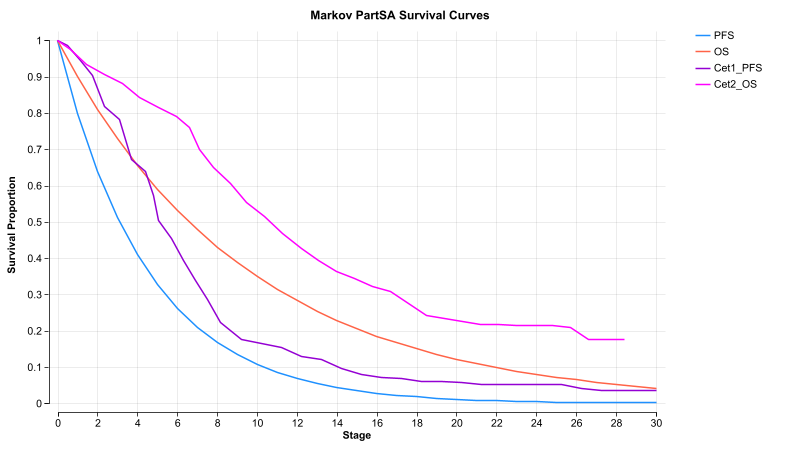
Consider the Healthcare Example Model, MarkovCalibration_1a_Fixed_PreCal.trex. Prior to calibration, the model's survival (i.e. model output) does not match clinical survival tables (i.e. target data) as shown in the Markov Plot below. (Red and blue lines are the model's survival/output).
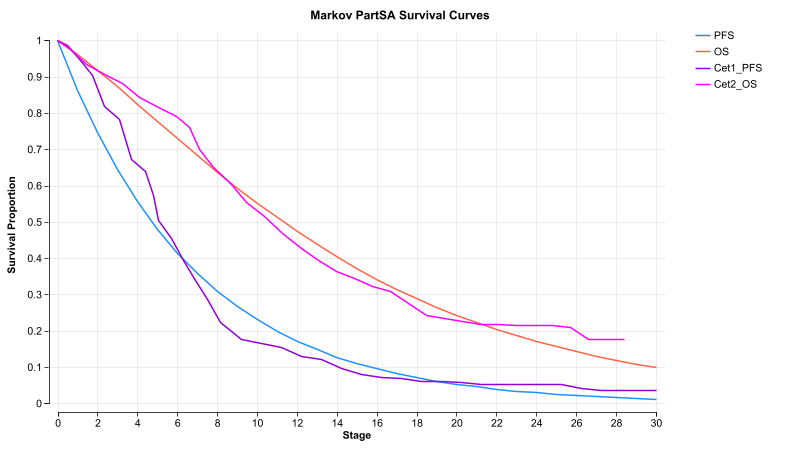
After the calibration, model survival (model output) matches clinical survival tables (target data) much more closely.
This following sections guide you through the full calibration process.