46.9 Setting up Payoffs for Calibration Targets
To calibrate your model to payoffs, you must first setup the appropriate outputs for matching to calibration targets.
In this example, we will setup and use a distinct payoff set for...
-
Progression-free 5-year survival
-
Overall 5-year survival
This section describes how we examined the model's survival data and then how we added model outputs specifically for that survival data.
In the Healthcare Example Model MarkovCalibration_3a_Payoffs_PreCal.trex, we can examine Markov Cohort Extended report to determine the 5-year survival (PFS & OS) currently generated by the model. (Run Markov Cohort Analysis, and from the Markov Dashboard open the State/Event Cohort Details, as shown below).
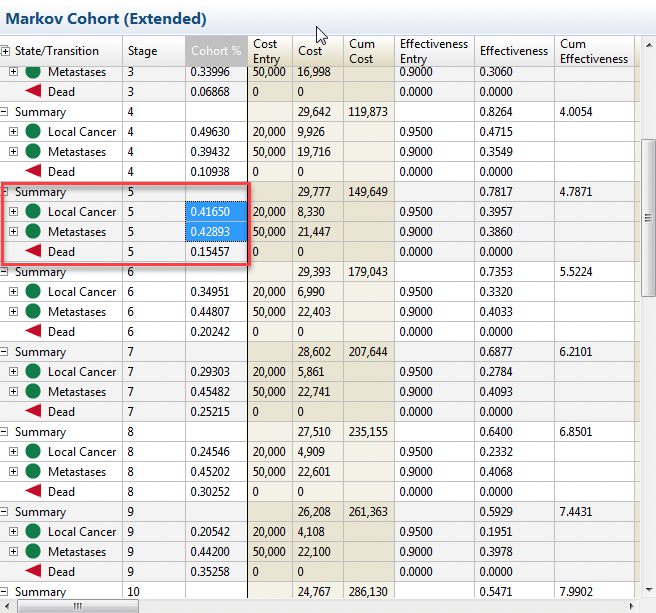
From the Cohort report above you can see the state probabilities (cohort%) at _stage 5 for Local Cancer and Metastases provide us with the 5-year survival values.
-
Progression-Free 5-year Survival (Local Cancer) is 0.41650
-
Overall Survival 5-year Survival (Local Cancer + Metastases) is 0.84543
However, imagine that our observed data for Tx1 is lower:
-
Progression-Free 5-year Survival (Local Cancer) is 0.401
-
Overall Survival 5-year Survival (Local Cancer and Metastases) is 0.836
This indicates that our model is overestimating survival. We did not look closely at Tx 2, but consider the same kind of survival overestimation for that strategy as well.
For the purposes of calibration, we need the PFS and OS 5-year survival to be an independent outcome of the model. Therefore, we need to create new payoffs specifically to return those values when the model is analyzed.
Healthcare Example Model, MarkovCalibration_3a_Payoffs_PreCal.trex already has the outcomes in place, but we can examine these elements of the model. Note that the model is setup for 7 payoff sets. This generates 5 extra outputs beyond the primary ones - cost and effectiveness. The section below shows the extra payoffs in the model.
Note: You could setup the 5-year survival payoffs using the Build Model Outputs wizard, described in the Build Model Outcomes Wizard - Markov Models section.
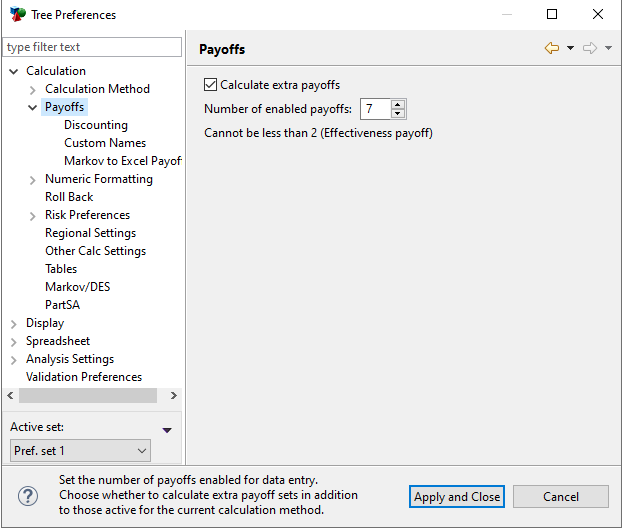
Custom payoff names are used to identify what each payoff set represents.
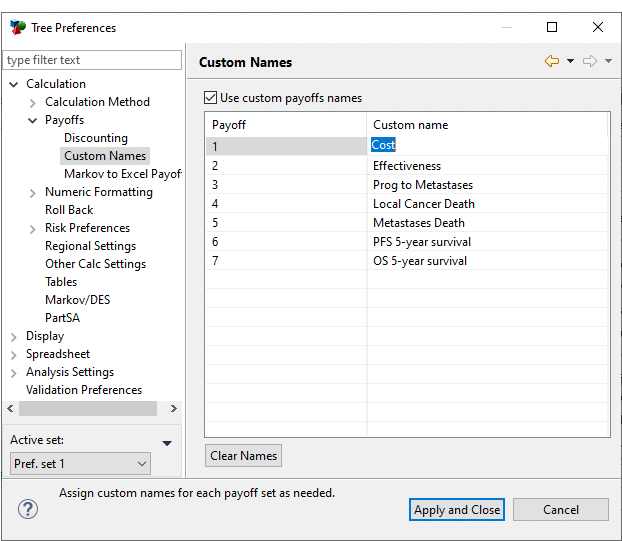
Those Tree Preferences settings establish the two survival measurements as model outputs/payoffs. The model also calculates those survival values appropriately within the Markov model.
In the figure below, you see the Markov View's Health States tab for Tx 1. Note that the state reward for the Local Cancer state in both payoffs 6 & 7 (survival) is the formula if(_stage=5; 1; 0). This formula returns 1 only at _stage 5, which is 5 annual cycles into the future. The "1" (in the if statement) is multipled by the cohort % in that state at that time, such that the output is the cohort %. Therefore, the payoff is only updated with the cohort % at 5 years, resulting in 5-year survival.
Since the Local Cancer state is progression-free, its cohort % is applied to both progression-free survival (payoff 6) and overall survival (payoff 7). However, the Metastases state is post-progression, so its cohort % is applied only to overall survival (payoff 7).
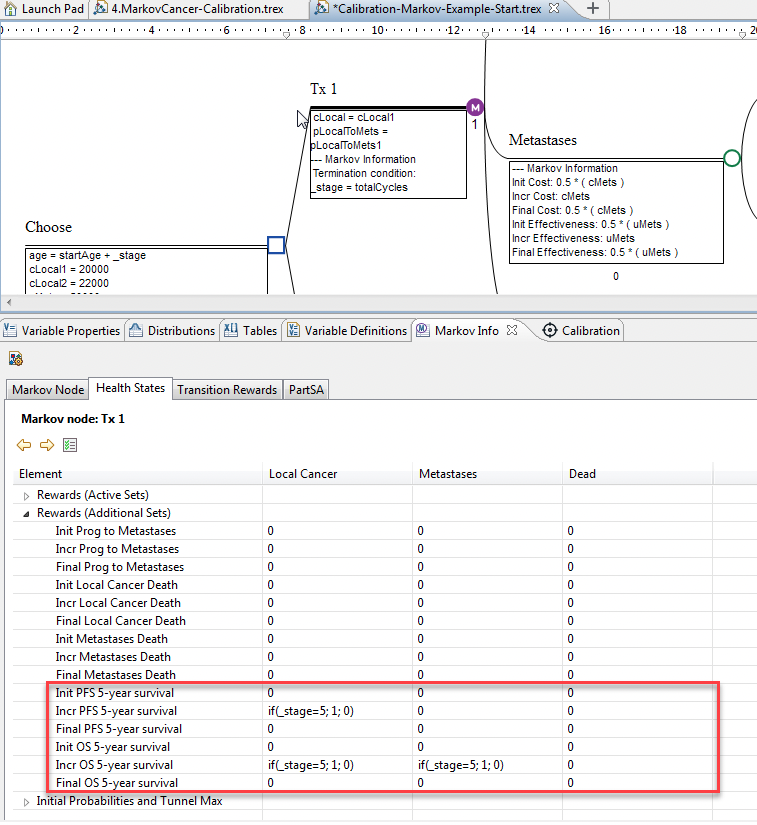
With these payoffs and state rewards in place, 5-year progression-free survival and 5-year overall survival are now primary outputs of the model, ready for use during calibration.