14.4 Calculate Probabilities from Survival/Hazard Tables
TreeAge Pro includes table functions that calculate event probabilities from survival and hazard tables.
-
ProbHazardTable("tableName"; startCycleTime; cycleLength)
-
Calculates an event probability from a hazard table.
-
-
ProbSurvTable("tableName"; startCycleTime; cycleLength)
-
Calculates an event probability from a survival table.
-
Notes for use of table functions above:
-
We strongly recommend that the underlying tables use the lookup method "interpolate" to avoid odd probability and hazard calculations from flat portions of the table.
-
Be careful using ProbSurvTable on an incomplete survival table. Once the survival data runs out, ProbSurvTable will return a probability of 0.
Both of these functions are demonstrated in the Healthcare Example Model TableFunctions-CDC-Markov.trex.
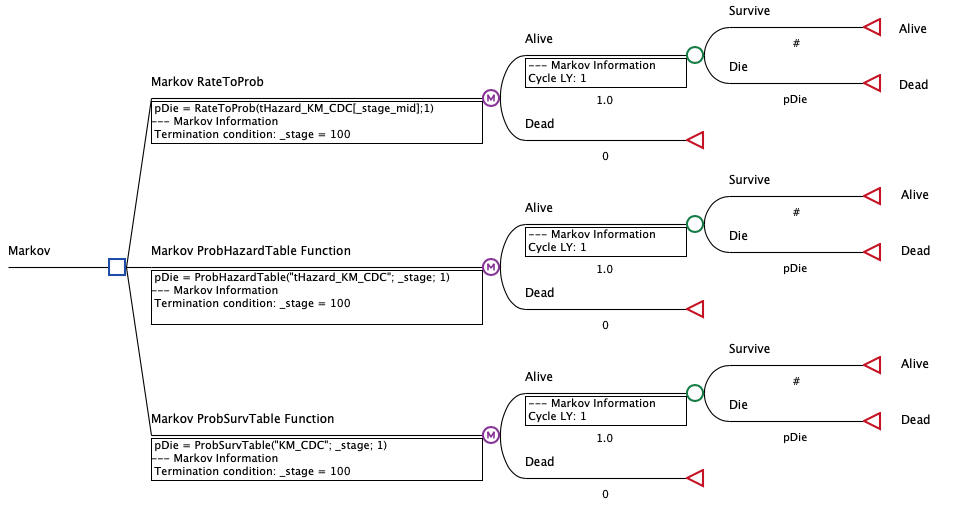
All strategies are simple 2-state Markov models tracking survival. However, the calculation of the pDie variables are different for each strategy so we can compare them. They differ in the following ways:
-
Strategy 1: Pull the hazard from the hazard table tHazard_KM_CDC for the midpoint of each cycle, then convert it to a probability.
-
Strategy 2: Use the ProbHazardTable function to calculate the probability directly from the hazard table.
-
Strategy 3: Use the ProbSurvTable function to calculate the probability directly from the survival table.
If you roll back the model, the results are nearly identical for the three strategies. The hazard-based strategies calculate the probability based on the hazard halfway through the cycle applied over the full cycle. The survival-based strategy results will differ slightly because this function calculates the probability based on survival 1 cycle into the future relative the survival in the current cycle.
TreeAge Pro also includes functions to calculate event probabilities from a Compound Curve.