
Discrete Event Simulation Models (DES)
Model What Happens Next—and When It Happens
TreeAge Pro lets you simulate individual patients in continuous time, with events occurring according to their time-to-event distributions rather than at fixed model cycles.
- Model competing events by sampling when each event may occur and determining which happens next.
- Represent event timing in continuous time using time-to-event distributions.
- Track patient events and history as individuals move through the simulation.
- Accumulate costs, utilities, and other outcomes as time passes and events occur.
Build DES Models Visually
Define Possible Events
Create branches for the competing events that can occur as patients progress through the model.

Model Competing Events in Continuous Time
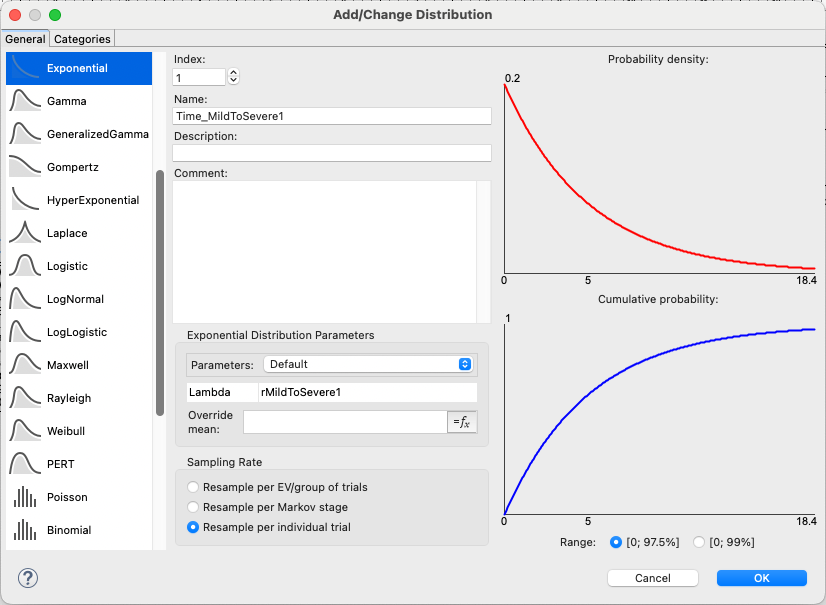
Track Events, Time, and Outcomes
Track what happens to individual patients over time and accumulate outcomes as events occur.
Track Patient Events and History
Retain information about prior events so patient history can influence what happens later in the simulation.
Model Repeating Events
Represent events that can occur multiple times during a patient’s simulated lifetime.
Accumulate Costs, Utilities, and Other Outcomes
Apply outcomes as events occur or accumulate them over time, allowing costs, utilities, and other measures to reflect each patient’s experience throughout the simulation.
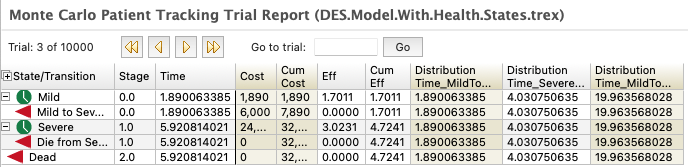
Analyze and Validate Your DES Model
Run Discrete Event Simulation to examine individual patient experiences and evaluate results across the simulated population.
Explore Patient and Population Outcomes
Review individual patient pathways and event timing, then aggregate results across the simulated population to evaluate costs, effectiveness, and other outcomes.
Analyze Cost-Effectiveness and Uncertainty
Use TreeAge Pro’s integrated analysis tools to evaluate cost-effectiveness and explore the impact of uncertainty in model inputs and assumptions.
Inspect and Validate Simulation Behavior
Use patient tracking and simulation reports to examine event timing, patient history, calculations, and outcomes and understand how the model produces its results.
Communicate and Share Your Model
Use the visual model and reports to explain model structure, event pathways, assumptions, and results.
Share models through TreeAge Pro Web so others can explore inputs, analyses, and results.