
Legal Decision Modeling: Case Valuation and Risk Analysis
How attorneys can use decision trees to evaluate litigation outcomes, quantify risk, and make better-informed decisions.
By Andrew Munzer
Bringing Structure to Litigation Uncertainty
Every experienced litigation attorney understands that the outcome of a lawsuit is uncertain. Even a strong case can produce an unfavorable verdict, while a seemingly weak case may succeed because of a particular legal ruling, a witness’s testimony, or a jury’s interpretation of the evidence.
Attorneys must evaluate these uncertainties when advising clients, developing litigation strategies, and negotiating settlements. These assessments draw on professional experience, knowledge of the law, the available evidence, and an understanding of how courts and juries may respond.
But complex litigation can involve numerous interconnected issues, each with its own possible outcomes. Evaluating the combined effect of these uncertainties can be difficult, even for experienced attorneys.
Legal decision modeling provides a structured framework for organizing these uncertainties, quantifying possible outcomes, and assessing the overall value and risk of a case.
Rather than replacing professional judgment, decision modeling helps attorneys apply that judgment systematically. It makes the assumptions behind a case evaluation explicit and provides a quantitative basis for examining the potential consequences.
The approach has a long history. Morris Raker, founder of TreeAge Software, was an early advocate of applying decision analysis software to litigation. His work explored how attorneys could use structured models to evaluate uncertainty and possible outcomes.
Today, the fundamental ideas remain relevant. By combining professional legal expertise with a visual decision model, attorneys can better understand the range of possible litigation outcomes, estimate case value, evaluate financial risk, and make more informed decisions.
What Is Legal Decision Modeling?
Legal decision modeling is the process of representing a lawsuit as a series of possible events, decisions, and outcomes. The most common approach uses a decision tree, a visual diagram that maps the paths a case might follow as legal issues are resolved.
A decision tree can represent questions such as:
- Will the court grant a motion for summary judgment?
- Will the jury find that the defendant breached a contract?
- Will the plaintiff establish that the breach caused damages?
- Will certain categories of damages be permitted?
- How much might the jury award?
Each uncertain event creates branches representing possible outcomes. As the tree progresses, these branches lead to different conclusions, including the financial consequences of each result. The attorney can assign probabilities to uncertain events and financial values to final outcomes.
The resulting model provides two complementary types of information: case valuation, a probability-weighted estimate of the financial outcomes of litigation; and litigation risk, an understanding of the range of possible outcomes and the likelihood of each. Expected value summarizes the case, while the distribution of outcomes reveals risks that one number cannot capture.
Step 1: Map the Structure of the Case
Consider a hypothetical dispute between TV Utilities (TVU) and Kool Coal (KC). TV Utilities alleges that Kool Coal supplied coal that failed to meet contractual specifications, causing damage to TVU’s equipment. The plaintiff claims $500,000 in direct damages and additional consequential damages associated with the alleged losses. TVU has demanded $1 million to settle the dispute.
We will examine the case from Kool Coal’s perspective as the defendant. This example was developed by Marc Victor of Litigation Risk Analysis, Inc., who has extensive experience applying decision analysis to litigation. It illustrates how a potentially complex dispute can be organized into a decision tree.
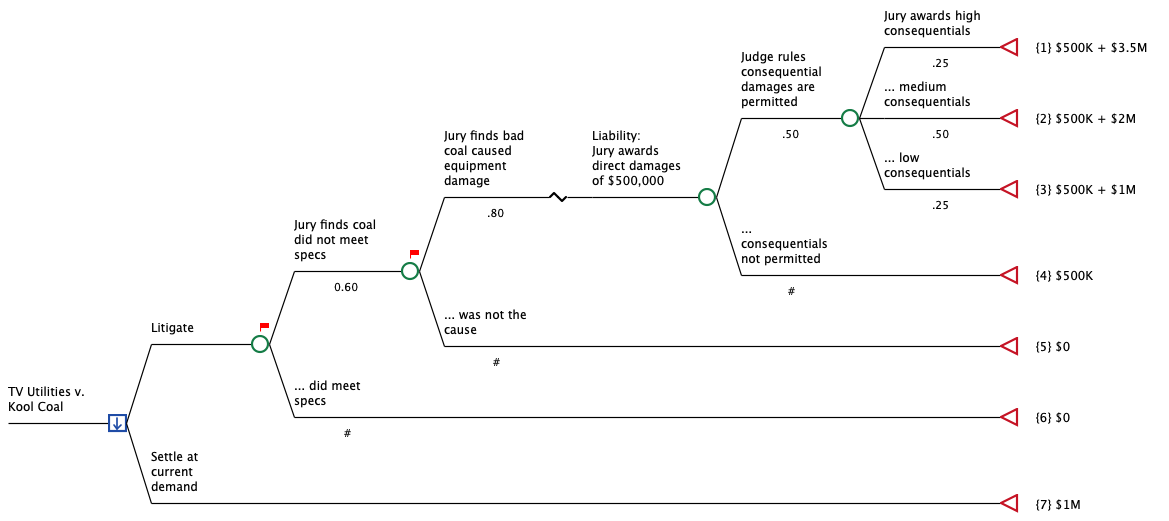
Figure 1. Building a litigation decision model. The TVU vs. KC tree organizes legal issues, possible outcomes, probabilities, and financial consequences.
Kool Coal example © Litigation Risk Analysis, Inc., used with permission.
The tree begins with two alternatives: litigate or settle at the plaintiff’s current demand. For now, let’s focus on the litigation branch. Rather than treating the case as a single question of whether Kool Coal wins or loses, the model separates the dispute into critical issues.
Did the coal meet specifications?
If the jury finds that the coal met contractual specifications, Kool Coal avoids liability under the claim represented in the model. If the coal failed to meet specifications, a second question becomes relevant.
Did the defective coal cause the equipment damage?
A finding that the coal did not meet specifications does not necessarily establish that it caused the alleged damage. The jury must resolve this additional issue. If it finds both that the coal failed to meet specifications and that it caused the damage, the model assumes an award of $500,000 in direct damages.
Are consequential damages permitted?
The model includes a judicial ruling on whether consequential damages are available. If not, the award is limited to $500,000. If they are permitted, the jury may award different amounts depending on its assessment of the plaintiff’s losses.
The decision tree captures several distinct paths to different financial outcomes. This is one of the principal benefits of legal modeling: it breaks a complex case into individual legal and factual questions that attorneys can evaluate separately. It also encourages attorneys to consider whether important issues or potential outcomes have been overlooked.
Step 2: Quantify the Uncertainties
Once the structure of the case has been established, the next step is to estimate the likelihood of uncertain outcomes. In this example, the following probabilities are assigned:
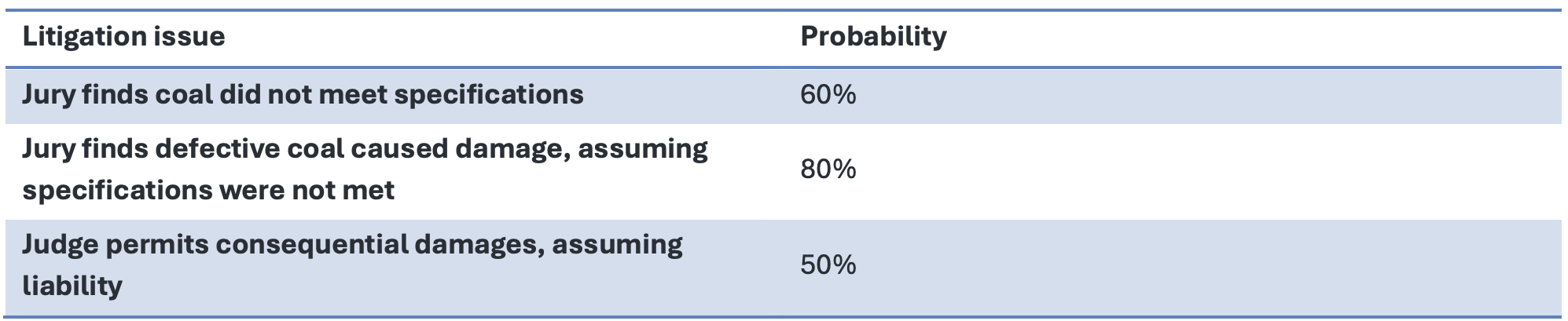
If consequential damages are permitted, the model assigns these probabilities:

These are hypothetical assessments used to illustrate the modeling process. In a real case, attorneys would develop estimates from the available evidence, relevant law, witness credibility, expert opinions, litigation experience, and other considerations. They need not imply mathematical precision: a 60% estimate is an informed assessment, not scientific certainty.
Each probability is evaluated in the context of preceding events. For example, the 80% probability of causation applies only after the jury has found that the coal failed to meet specifications. This allows the model to combine multiple uncertainties correctly.
The Value of Making Assumptions Explicit
Assigning probabilities can be challenging. Attorneys may disagree about the likelihood of a favorable ruling or the significance of evidence. But that discussion is itself valuable. Rather than saying a case is simply strong or weak, the model encourages attorneys to identify exactly where uncertainty lies and what supports each assessment.
It can also show where further investigation, discovery, or expert analysis might be especially valuable. As a case develops, probabilities can be updated. A decision model can remain useful throughout litigation rather than serving only as a one-time valuation exercise.
Step 3: Calculate the Expected Value of Litigation
With the case structure, probabilities, and financial outcomes established, we can calculate expected value. Multiply each possible financial outcome by its probability, then add the results to obtain the probability-weighted average.
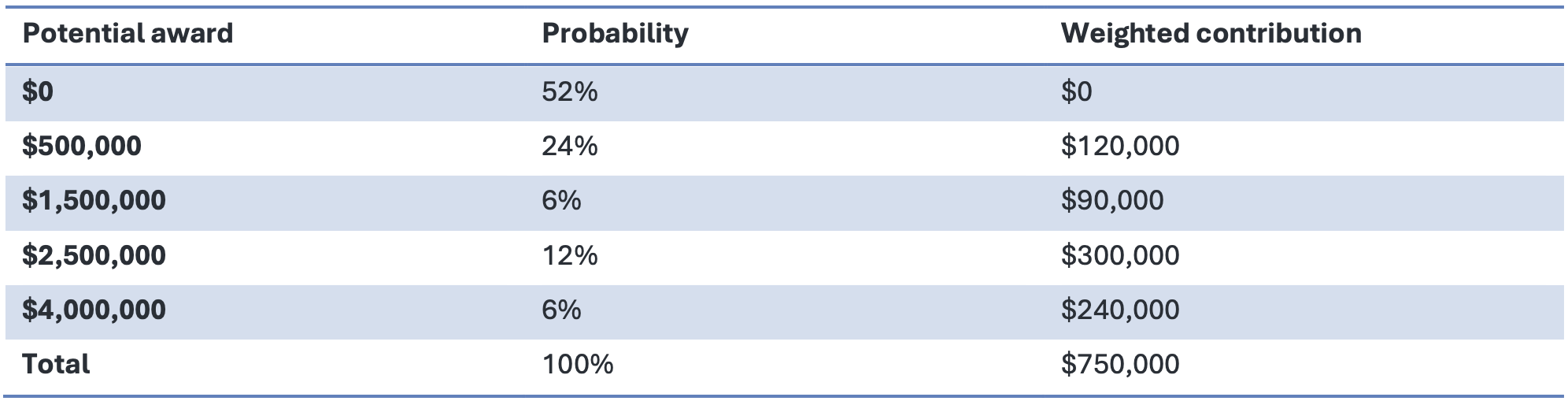
The expected litigation award is $750,000. From Kool Coal’s perspective, this represents expected award exposure if the case proceeds through the modeled litigation outcomes. From TV Utilities’ perspective, it represents expected gross recovery if both sides use the same probabilities and awards. In practice, opposing attorneys may arrive at different estimates.
Figure 2. Calculated model showing the $750,000 expected award and $1 million settlement demand.
© Litigation Risk Analysis, Inc., used with permission.
What Does Expected Value Mean?
The $750,000 figure does not predict that the court will award exactly that amount. In fact, $750,000 is not one of the possible awards in the model. Expected value combines all five outcomes into a single measure. It provides a starting point for evaluating a case, not every piece of information needed for a litigation or settlement decision.
Step 4: Understand Litigation Risk
Consider two cases with identical expected values of $750,000. In one, virtually every possible outcome might fall near that amount. In another, there might be a substantial chance of no recovery and a smaller chance of several million dollars. Their expected values are identical, but their risk profiles differ.
The TVU vs. KC model indicates a 52% probability that Kool Coal will pay no damages under the modeled outcomes. At the other extreme, there is a 6% probability of a $4 million award, a 12% probability of $2.5 million, and a 6% probability of $1.5 million.
Kool Coal may have a greater-than-even chance of avoiding liability yet still face meaningful exposure to a multimillion-dollar award. The expected value reflects these possibilities but cannot convey the complete risk picture by itself.
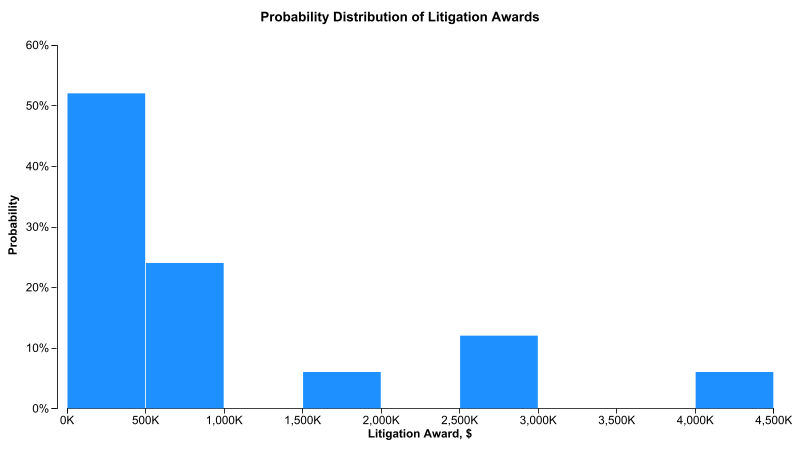
Figure 3. Understanding litigation risk. The distribution shows the probability of five possible awards: $0 (52%), $500,000 (24%), $1.5 million (6%), $2.5 million (12%), and $4 million (6%).
For some clients, the possibility of a large adverse judgment is a critical concern; others may be better positioned to absorb it. The model supplies quantitative information, while attorney and client consider how the possible outcomes align with the client’s circumstances, objectives, and risk tolerance.
Step 5: Compare Litigation Value with Settlement Opportunities
TV Utilities has demanded $1 million to settle. Kool Coal’s expected award exposure is $750,000. The demand is therefore $250,000 higher than the modeled expected litigation award. This provides an important starting point, but it does not establish that Kool Coal should reject settlement and proceed to trial.
The $750,000 expected award excludes legal fees, expert costs, and other expenses of continued litigation. It does not fully reflect the consequences of a large adverse judgment. The client may also care about management time, business relationships, reputation, and finality.
And the settlement demand need not be treated as fixed. The model provides a quantitative foundation for considering counteroffers and discussing whether a proposed settlement is reasonable in light of exposure and risk. It informs the attorney’s discussion with the client without making the decision for them.
What About Litigation Costs?
This example focuses on court awards rather than net financial consequences. A more comprehensive model could incorporate future legal fees, expert costs, other litigation expenses, and timing of payments. Costs generally increase the defendant’s burden of continuing litigation and reduce the plaintiff’s net recovery, although fee shifting and expense recovery may alter the treatment. We keep the introductory example focused on awards, while recognizing that expected award and expected net financial value are not the same.
Why Both Parties May Benefit from Settlement
Plaintiff and defense counsel often value the same case differently. They may disagree about the probability of liability, likely damages, or the significance of legal issues. They may also face different expenses and different consequences from proceeding.
Suppose the plaintiff considers $700,000 preferable to continued litigation after accounting for recovery, expenses, and uncertainty. The defendant might find paying as much as $900,000 preferable to continued litigation based on its own estimates and risk. A settlement between those figures could be acceptable to both. These figures are illustrative, not additional results from the TVU vs. KC model.
The parties need not agree on one case valuation for settlement to be possible. Different assessments of litigation risk and financial consequences can create an overlapping range of acceptable settlement terms. Decision modeling provides a systematic basis for evaluating these differences.
Testing Assumptions as the Case Develops
Every model depends on assumptions, some better supported than others. Attorneys can use sensitivity analysis to examine how changing probabilities or damages estimates affects expected case value. For example, a different assessment of whether consequential damages will be permitted would change Kool Coal’s estimated exposure.
Such analysis identifies assumptions that matter most and uncertainties deserving attention. As evidence develops, rulings emerge, or proposals change, the model can be updated. Legal decision modeling thus supports ongoing evaluation rather than one calculation at a single point in time.
Communicating the Analysis
Decision modeling can also help explain complex litigation assessments. Attorneys often must communicate recommendations to clients unfamiliar with every issue or the reasoning behind a proposed settlement. The decision tree shows how the legal questions, outcomes, and assumptions fit together.
For example, a TVU vs. KC client can see why expected award exposure is $750,000 even though a $4 million judgment is possible. The client can also explore how assessments of liability or consequential damages affect the result.
The framework supports discussions among litigation team members, outside counsel, and decision-makers. It encourages participants to focus on identifiable assumptions instead of unexplained disagreements about overall value. The tree’s benefit is not limited to calculation; it creates a common framework for understanding and discussing a complex case.
Putting Legal Decision Modeling into Practice
Attorneys do not need advanced mathematical expertise to benefit. The essential inputs come from their knowledge of the case: issues, evidence, possible outcomes, estimated probabilities, and financial consequences. The analytical framework organizes those inputs.
A simple dispute may be evaluated with a hand-drawn tree and straightforward calculations. For more complex cases, specialized decision analysis software makes the process more manageable.
TreeAge Pro Business offers a visual environment for constructing legal decision trees, assigning probabilities and financial values, calculating expected case value, examining outcome distributions, and exploring the effects of changing assumptions. More complex cases may include additional claims, defenses, rulings, or damages calculations within the same framework.
Throughout, the attorney remains responsible for the legal assessments. The software manages structure and calculations, allowing attention to remain on legal reasoning and decisions.
Conclusion: Better-Informed Litigation Decisions
Litigation will always involve uncertainty. No model can eliminate that uncertainty or guarantee a judicial outcome. Legal decision modeling helps attorneys understand it more clearly.
By mapping a case, assigning probabilities, and evaluating financial consequences, attorneys can develop a systematic understanding of value and risk. TVU vs. KC produces an expected award of $750,000, but also shows a 52% probability of no award and a smaller possibility of multimillion-dollar damages. Comparing these results with a $1 million settlement demand offers a starting point, while highlighting the importance of legal expenses, risk tolerance, and other considerations.
Legal decision modeling does not replace the experience and judgment of a skilled attorney. It provides a structured way to apply that expertise, examine uncertainty, quantify financial consequences, and support better-informed decisions.
Explore Legal Decision Modeling with TreeAge Pro
TreeAge Pro Business provides a visual framework for evaluating litigation outcomes, estimating case value, and understanding financial risk.
Explore TreeAge Pro for Lawyers to learn more about the software, free training, and product evaluation opportunities.
Explore TreeAge Pro Legal Modeling
The TV Utilities vs. Kool Coal example is © Litigation Risk Analysis, Inc., and used with permission.